Already a Subscriber? Log in
Get Instant Access to This Article
Subscribe to Mainebiz and get immediate access to all of our subscriber-only content and much more.
- Critical Maine business news updated daily.
- Immediate access to all subscriber-only content on our website.
- Bi-weekly print or digital editions of our award-winning publication.
- Special bonus issues like the Mainebiz Book of Lists.
- Exclusive ticket prize draws for our in-person events.
Click here to purchase a paywall bypass link for this article
Last year when the U.S. government began buying equity stakes in companies active in strategic industries from minerals to semiconductors, leaders at Elmet Group Co. took notice.
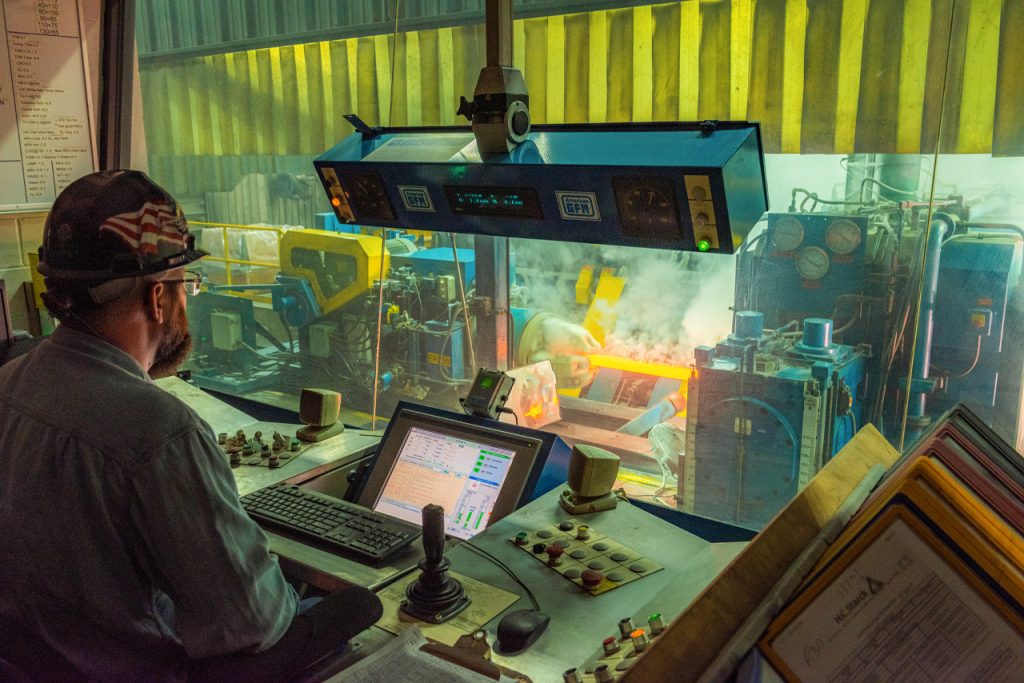
The niche manufacturer, whose Lewiston industrial roots go back nearly a century making tungsten for lightbulb filaments for Netherlands-based Royal Philips, saw an opportunity to cash in on its cachet as the only U.S.-owned and -operated, vertically integrated manufacturer of pure tungsten and molybdenum products and parts.
Tungsten is a hard, dense, heat-resistant metal mined from the Earth’s crust in no more than a dozen countries, predominantly China. It is used in satellites, rockets, missiles, submarines, medical imaging and electronics.
After years as a supplier to federal defense programs, Elmet set out to woo Uncle Sam as an investor. It began by contacting the U.S. departments of Defense and Commerce — two of the four agencies that have gone on a buying spree since Japan-based Nippon Steel’s $15 billion cash acquisition of U.S. Steel. The deal, initially blocked by President Joe Biden in January 2025, was approved by President Donald Trump that June via a national security agreement that granted the U.S. government a “golden share” veto right over major strategic and operational decisions. The following month, the Defense Department paid $400 million for 15% of MP Materials, a Las Vegas-based rare-earth magnet manufacturer that struck a long-term supply deal with Apple five days later. Anticipating a new era of government stockpiling and shareholding, Elmet leaders began courting government officials more than a year ago.
“We were just waving this flag that we have this amazing business in Maine,” recalls Scott Knoll, executive vice president of corporate strategy at Elmet, a Portland-based company that incorporated in Delaware in 2024. Fully aware that “we weren’t the only tungsten business they [government officials] were talking to,” Elmet pressed ahead while pursuing its own acquisitions and public share sale that raised a net $125.5 million, making its pitch to government officials.
“It was not quick, but over the year it came together,” Knoll says.
$450M deal to gain ‘gravitas’
Talks between Elmet and government officials led to a deal this September that saw the Defense Department invest $450 million in the company to “strengthen domestic tungsten capacity, bolster U.S. industrial resilience and military readiness and help secure an essential material for the defense industrial base,” as per the Pentagon’s official wording.
The arrangement gives the government a 19.9% stake in Elmet — just below the 20% threshold for a controlling interest — plus a board seat and nonvoting board observer.
Elmet plans to use the funds for factory upgrades and expansions. It’s also counting on Washington’s involvement to boost its standing with large commercial customers from Raytheon to Lockheed Martin.
“It gives us gravitas, when we talk to some of these larger companies, to say that the Department of War owns 20% of us,” says Peter V. Anania, Elmet’s CEO. “It opens more doors.”
The stock has fared well amid a bumpy phase for the market, climbing 32% in the three weeks following the deal announcement while the Standard & Poor’s 500 index mustered only a 1.5% increase.
Industrial policy shift
Since June 2025, the federal government has taken stock, warrants, a golden share or a profit interest in 35 companies through the departments of Commerce, Defense, Energy and Treasury.
Although there is no official list, Los Angeles-based consulting firm OAG SEO estimates that the government has invested close to $18 billion in those companies, including Elmet. Around half of the total is represented by an $8.9 billion investment in Intel Corp. for a nearly 10% stake in the California-based semiconductor maker. The most recent investment, $65 million in a $135 million Series A venture capital fundraising round for Hertha Metals, is aimed at helping the Texas-based startup transform steelmaking.
The federal government has a long history of intervening in private industry, from railroad expansion under the Lincoln administration to Truman’s seizure of steel mills in 1952 — deemed unlawful that same year by the Supreme Court — to bailouts of banks, insurers and carmakers in the wake of the 2008 financial crisis.
Today, with private-sector consent, the Trump administration is writing a new chapter in U.S. industrial policy through investments in semiconductors, nuclear energy and critical minerals like the tungsten and molybdenum that Elmet refines and processes at its factories in Ohio, Michigan and Maine. Its products include molybdenum nozzles used in missile defense systems.
Having a sizeable stake in Elmet gives Washington a long-term domestic source of tungsten, helping preserve U.S. capacity as China’s dominance of the market drives up prices—tungsten concentrate has roughly tripled since January — and the wars in Ukraine and Iran fuel demand for military hardware. While a 2018 law bars the Defense Department from buying tungsten powder and heavy alloys made in China, Russia, Iran or North Korea, the ban will also apply to tungsten mined or refined in those countries as of Jan. 1, 2027, even if it’s processed elsewhere, creating an even greater need for supply diversification.
War and peace
Meghan Welch, a Florida-based managing director with Brown Gibbons Lang & Co., says the Iran war has heightened the urgency of expanding domestic tungsten production.
“That changes the question from ‘How many missiles do we have?’ to ‘How quickly can we manufacture the next thousand?’” says Welch, who leads the investment bank's aerospace, defense and government services advisory practice. “Once you ask that question, you move upstream to rocket motors, castings, critical minerals, and, ultimately, raw materials such as tungsten. That is what makes Elmet particularly interesting.”
But with defense accounting for only 12% of global tungsten demand, the case for Elmet extends beyond the current conflicts, says Kevin Compher, who founded a Portland-based venture called First Light Works that aims to fast-track defense innovation across New England.
“Elmet’s deal runs on a 10-year horizon, refilling a stockpile is peacetime work and the 2027 ban on Chinese tungsten in defense supply doesn’t expire with a truce. There is no armistice in the competition with China,” he says.
As Elmet approaches its 100th anniversary in 2029, the firm aims to lay the foundation for the next 100 years by using proceeds from its IPO and fresh government capital to add to its 600-strong workforce, around half of whom are based in Maine.
The Defense Department has said its investment will preserve high-paying jobs in Ohio, bolster demand for upstream mining jobs in Nevada and support around 1,200 downstream jobs across manufacturing, engineering and logistics networks tied to major defense suppliers.
Firepower ‘to grow and hire’
Elmet’s investment plans include $165 million across three of its six manufacturing locations, allocating $150 million to develop a tungsten complex in Nevada, and establishing a new division to coordinate sourcing, refining and delivery activities across a diversified supply chain.
Elmet has also been expanding through acquisitions, most recently in Vietnam and the U.K.
While the company was recently awarded a $36 million U.S. defense contract to supply high-performance alloys and precision wire for the national defense stockpile, Knoll underscores that the Defense Department is not often a direct purchaser of Elmet’s supplies. For example, the company sells radar components for the Patriot missile defense systems to Raytheon and aircraft de-icing support wire to PPG Aerospace, which then sells them to aircraft manufacturers.
“We’re down in the supply chain, [and] we’re obviously not selling tungsten directly to the U.S. government,” he says. Nevertheless, he says that having the government as a shareholder boosts the company’s profile when dealing with private suppliers.
“If you’re talking to a Raytheon or a Lockheed or an Apple or whoever, it’s a little company in Maine they’ve never heard of,” Knoll says. “Hopefully this will help us as we try to grow and invest and hire in Maine.”
Out of 60 current job openings at Elmet from entry-level production workers to skilled machinists, 20 are for roles at its factories in Lewiston and Gorham, home of the firm’s Microwave Techniques subsidiary.
‘Patient capital’ and caveats
For Elmet, having the government as an investor brings challenges as well, including potential friction with the interests of private shareholders.
“The government is not running Elmet, but it now has meaningful governance, information and economic rights,” Welch says. “That introduces a stakeholder whose objectives aren’t exclusively financial. National security, continuity of supply, domestic capacity and resilience can legitimately matter alongside Ebitda, cash flow and shareholder returns.” (Ebitda, short for Earnings before Interest, Taxes, Depreciation and Amortization, is a measure of core operating profitability.) She also says the arrangement can affect strategic flexibility for future financing, partnerships, ownership and mergers and acquisitions.
“Government investment can simultaneously make an asset more strategically valuable while potentially narrowing the universe of parties that can ultimately own it,” she says.
Welch also notes that government ownership shouldn’t automatically be interpreted as preferential treatment. “Maintaining separation between the government’s role as a shareholder and its role as a customer will be important, particularly if this model becomes more important,” she says.
Yang Fan, who teaches investing and behavioral economics at Colby College in Waterville, warns of a similar gap.
“Private shareholders care about maximizing long-run profits and hence want to sell to the highest bidder,” he says. “Government incentives might be geared more toward national security, and hence the government might strategically prefer not to sell to certain buyers.”
He also says that while the government’s involvement reduces financing and investment risk for Elmet, that likely comes with some costs in terms of financial and strategic flexibility. That was the case for Intel, which faced higher costs when spinning off its foundry business because of an obligation to either maintain at least 51% ownership or trigger a warrant that would have allowed the government to acquire another 5% stake in Intel.
“That meant Intel’s foundry business was much more costly to spin off or sell,” he says. “This is both a financing and strategic constraint.”
Lessons and regulatory oversight
Compher, of First Light Works, sees two lessons for other Maine manufacturers from Elmet’s dealings with Uncle Sam, especially those offering something scarce.
“Elmet got these terms because it is the only U.S.-owned, fully integrated tungsten producer and Washington had few domestic alternatives,” he says. “Maine has more companies like that than people realize — in materials, composites, shipbuilding and precision machining. If you make something the country can’t easily get anywhere else, you have more negotiating power than you think.”
But Compher cautions that equity investments are better-suited to mature companies like Elmet, which can more easily accommodate a government partner with a board seat and other rights.
“For a younger company,” he notes, “that same partner can complicate every future financing and scare off private investors. For most of them, a committed purchase contract is the better deal: the government as a customer, not an owner. That keeps the company investable and the market competitive.”
With regulatory oversight of government investments in private companies still a gray area in the U.S., Compher recommends holding the government to the same standard as the world’s sovereign wealth funds, which made voluntary pledges of transparency, independence from politics and investing on commercial terms under the Santiago Principles adopted in 2008.
“If those rules were good enough for Abu Dhabi and Singapore,” Compher says, “they are good enough for us.”