Already a Subscriber? Log in
Get Instant Access to This Article
Subscribe to Mainebiz and get immediate access to all of our subscriber-only content and much more.
- Critical Maine business news updated daily.
- Immediate access to all subscriber-only content on our website.
- Bi-weekly print or digital editions of our award-winning publication.
- Special bonus issues like the Mainebiz Book of Lists.
- Exclusive ticket prize draws for our in-person events.
Click here to purchase a paywall bypass link for this article
A Penobscot County company has found a global customer base for its water- and ammonia-testing technology.
Orono Spectral Solutions in Hermon was founded in 2004 as a University of Maine spinoff to develop a water sampling extractor fitted with a membrane that captures trace oil.
The samples are paired with infrared spectroscopy instruments, made by other manufacturers, to analyze the traces. Orono Spectral sells both water- and ammonia-sampling tests — ClearShot and ClearSampler.
With water quality a major issue around the world, its customers have been in North America, Latin America, Europe, the Middle East, Africa and Southeast Asia. Customers include refineries, power plants, chemical and ammonia producers, offshore operators, wastewater labs and research groups.
Founders Carl Tripp and Luke Doucette developed the sampling technology and continue to advise the company. The products are made by Montville custom contract manufacturer Pieceworks Inc.
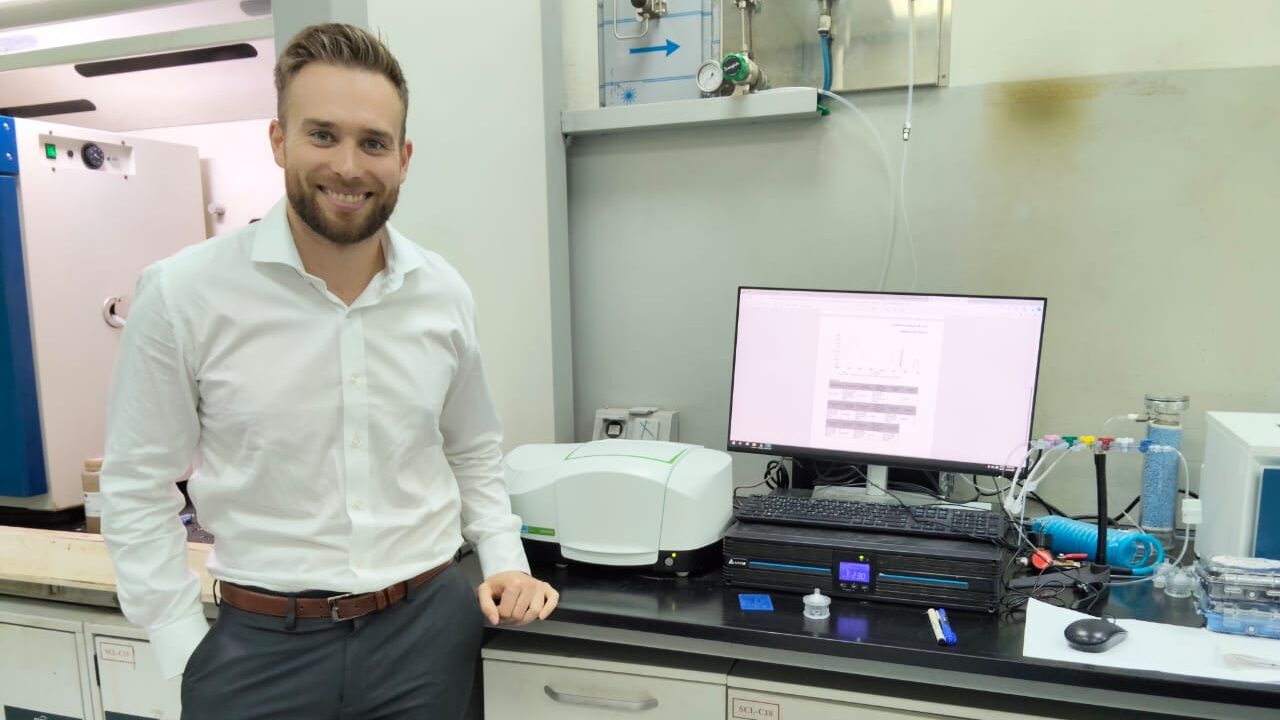
CEO Graham Roeber joined the company in 2025 and leads commercial strategy and growth.
Mainebiz: What does your staff consist of and what are their roles?
Graham Roeber: There are three of us and we have a fractional CFO and one sales contractor in the Middle East. We have a stockroom and we manage fulfillment globally, provide application support once customers receive it and we have R&D.
MB: What are common uses for these products?
GR: Every industrial facility has to measure oil in their water or ammonia. [Ammonia is used to make fertilizer.] For example, power plants and oil platforms take water from some body of water — a river or lake, the ocean or pond — then use that water in their processes to cool or mix. When they’re done with that water, they discharge it back. Regulatory bodies want to make sure these companies aren’t contaminating local bodies of water. We have customers all over the world — a beauty product manufacturer in Illinois, nuclear power plants in Canada, refineries in Saudi Arabia, desalination plants in the Middle East.
MB: What does your product consist of?
GR: ClearShot is an extractor with a filter. You take a syringe full of liquid, pass it through the extractor and the oil remains on the filter while the rest of the fluid passes through. We place the extractor with the oil into an infrared light beam and that allows you to see the amount of oil present in that sample. It lets the manufacturer know if there’s an issue.
MB: Do you sell the infrared light technology, too?
GR: No. That’s where some of the larger name brands we work with come in, like Thermo Fisher Scientific, which makes infrared instruments. That allows us to have a small presence in Hermon while also having a global presence.
MB: What are your production trends?
GR: We sell about 110,000 units per year. Pieceworks has made 88,000 so far this year and we’ll do another 20,000 by the end of the year.
MB: Revenue trends?
GR: We grew 44% last year. This year, our Middle East market took a little dent. So we pushed into the Asian market, which is picking up.
MB: What does conventional lab testing look like?
GR: You mix a solvent into your oily water sample. Then, using traditional wet chemistry — glassware and instruments like separator funnels and rotary evaporators, a fume hood, four to five square feet of table space for all the glassware — you evaporate the solvent off, then weigh on a balance how much oil is left in that sample. It takes about four hours and a lab technician. And solvents, like hexane, are known to be neurotoxins.
Our setup is the size of a toaster and we have guys who run this on pop-up plastic tables. It takes 10 to 15 minutes.
MB: How does your small company compete for global industrial customers?
GR: I use the analogy of suckerfish on whales. You have the large instrument manufacturers worth billions of dollars per year in revenue and an established presence in every market. On the other side, those huge companies can’t develop all of the applications for all their instruments. We’re a lot smaller and can move faster to develop solutions to use with their instruments. So we’re able to use their global sales and distribution network, instead of me having to fly around the world from lab to lab.
MB: How have you been developing these relationships?
GR: This was a major reason I was hired. A lot of it is me going to their headquarters, taking a few test cases and saying, "Hey, we sold 20 of your instruments in Saudi Arabia. Can we start working together and use your reach and your base?" We’re starting to see that work. The hardest part was getting enough traction in the beginning in order to be able to show that we move the needle for them.
MB: Will you be hiring?
GR: Yes. We will need more sales support. I have to take late-night, early-morning meetings to support and train distributors around the world. That’s why we recently brought on help in the Middle East.
MB: Further plans?
GR: We’re working on new applications for these products and we’re developing some new product lines. In the ammonia market, we’re measuring oil in ammonia, which is becoming a bigger issue as we see ammonia being used as a green fuel. That’s a new market, so we’re on the front edge.
