Already a Subscriber? Log in
Get Instant Access to This Article
Subscribe to Mainebiz and get immediate access to all of our subscriber-only content and much more.
- Critical Maine business news updated daily.
- Immediate access to all subscriber-only content on our website.
- Bi-weekly print or digital editions of our award-winning publication.
- Special bonus issues like the Mainebiz Book of Lists.
- Exclusive ticket prize draws for our in-person events.
Click here to purchase a paywall bypass link for this article
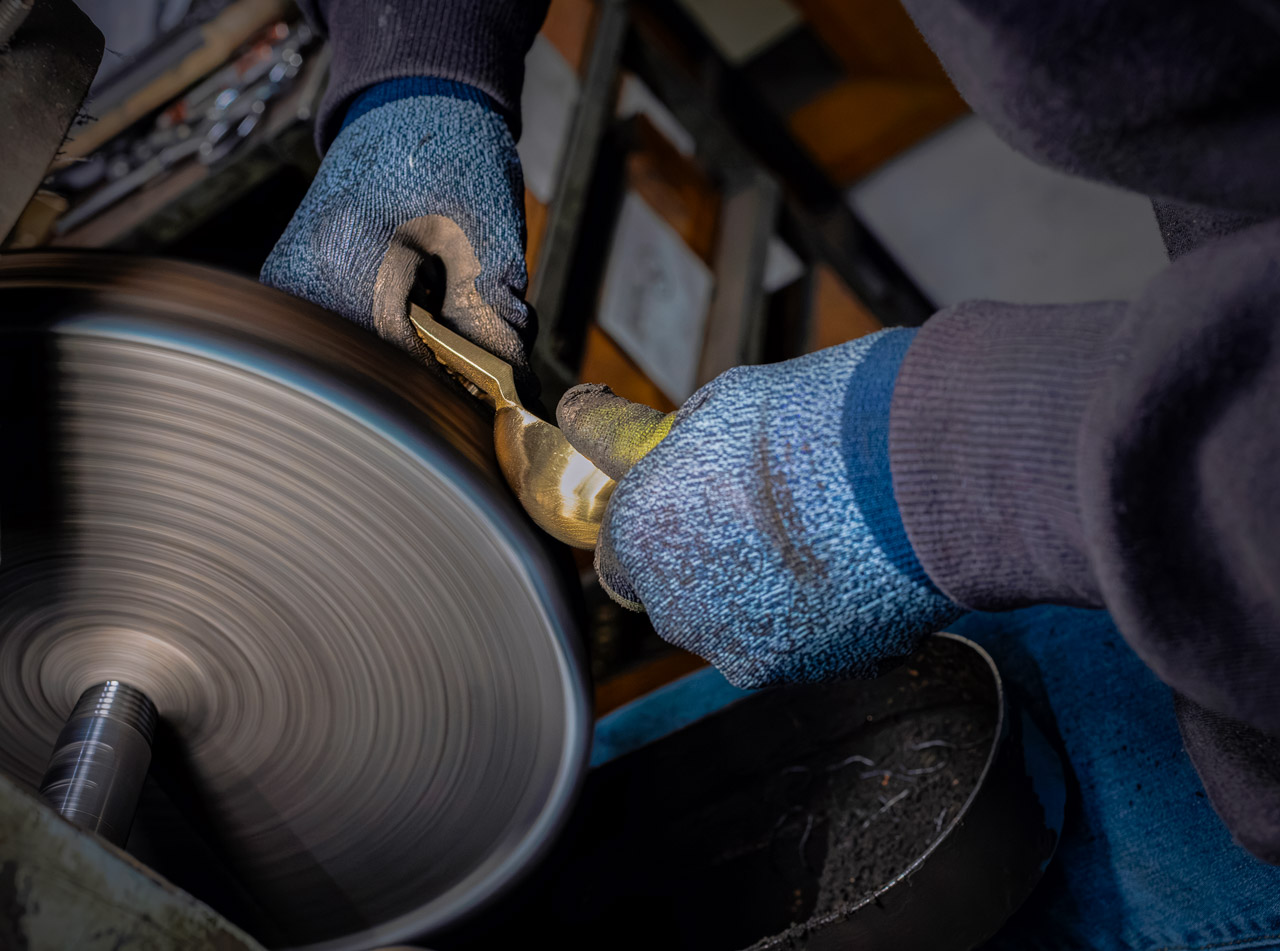
A chorus of high-pitched whirring machines filled the polishing room at Lie-Nielsen Toolworks, where workers put the finishing touches on bronze pieces.
The company makes high-end woodworking tools at its 30,000-square-foot facility on U.S. Route 1 in Warren, including hand planes, chisels, saws and spokeshaves. Its customers include furniture makers and boat builders.
For Cheyanne Cookson, who has worked at Lie-Nielsen for six years, the final stage of making those tools is among the most demanding.
“Getting it beautiful, getting it smack-dab perfect is the hardest thing to do, but it really does come together in the end,” says Cookson.
Technology can handle much of the machining, but some work still requires something a machine cannot provide.
“You gotta use every sense that you have to actually make it look good,” Cookson says. “Once it gets to that fine-tuning, you really need a person’s hand.”
Hand planes remain Lie-Nielsen’s signature product, with standard bench planes ranging from about $300 to $575.
From shed to shop
Thomas Lie-Nielsen started the company in 1981 in a 400-square-foot shed on a Rockland blueberry farm. He built his first hand plane with equipment from a retiring toolmaker.
Now employee-owned, the company has 75 employees. The company makes more than 60 types of tools, producing 600 to 700 individual tools a week.
Lie-Nielsen ships worldwide. Its clientele ranges from beginners to fine furniture makers and craftspeople whose work appears at the Smithsonian and the White House.
Some tools now pass between generations.
At a recent meeting, Robin Macgregor Nolan, vice president and chief operating officer at Lie-Nielsen, read employees a letter from a veteran who had found purpose through woodworking and using their tools.
“I don’t want to be overly dramatic, but you guys saved my life,” the veteran wrote, according to Nolan.
For Nolan, the letter spoke to something larger. “I think making things with your hands is an inherent part of the human condition.”
How it’s made
A Lie-Nielsen hand plane combines metal components with hand-finished wood parts. For the No. 62 Low Angle Jack Plane, the body is CNC-milled, sanded and powder-coated, then further machined and surface-ground for precision. The steel blade is machined, heat-treated and sharpened. The bronze cap is polished by hand. And the cherry knob and handle are sanded, oiled and buffed before assembly.
Lie-Nielsen moved to computer numerical control technology in the 1990s. These machines use computer-programmed instructions to control machining tools. Today, CNC is the company’s largest department, with pandemic-era investments helping offset retirements and labor shortages.
But there’s a limit to how far Lie-Nielsen wants to take it, Nolan says. “Investing in automation but not too much automation.”
