Already a Subscriber? Log in
Get Instant Access to This Article
Subscribe to Mainebiz and get immediate access to all of our subscriber-only content and much more.
- Critical Maine business news updated daily.
- Immediate access to all subscriber-only content on our website.
- Bi-weekly print or digital editions of our award-winning publication.
- Special bonus issues like the Mainebiz Book of Lists.
- Exclusive ticket prize draws for our in-person events.
Click here to purchase a paywall bypass link for this article
The Rockland workboat division of Thomaston boatbuilder Lyman-Morse has had two interesting projects in the works for separate Maryland customers.
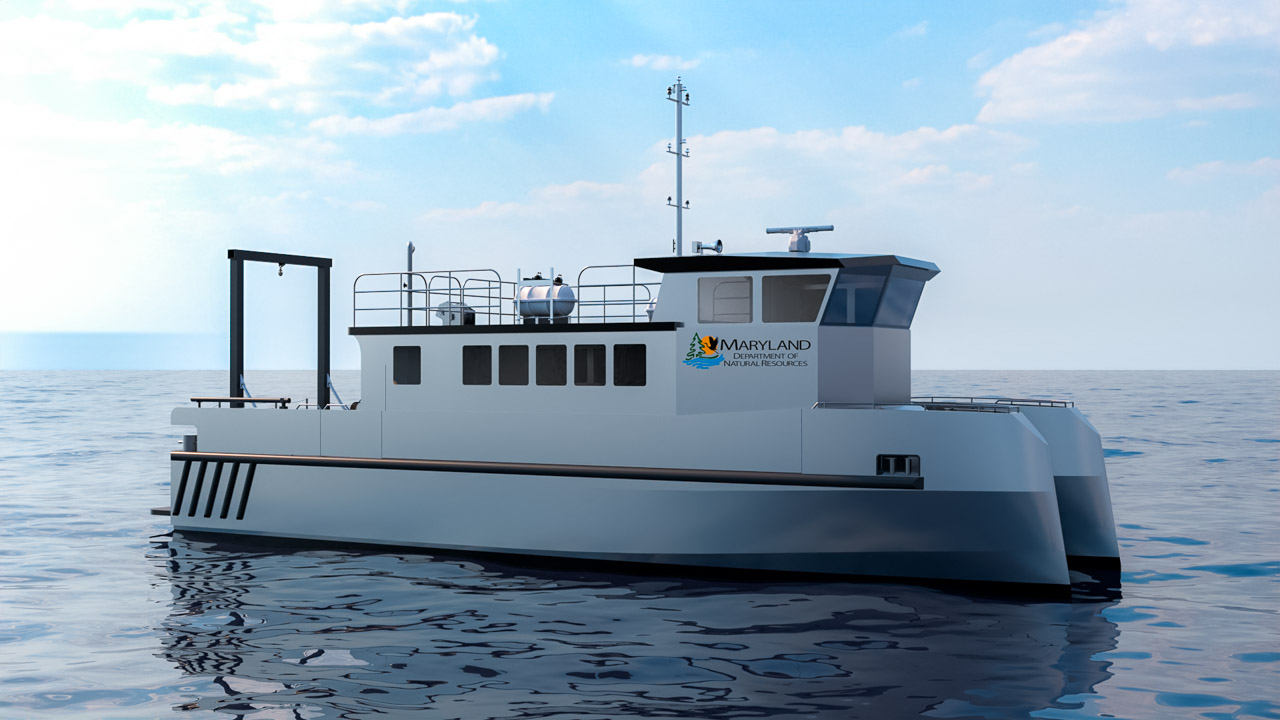
It won a contract to build a specially designed 59-foot aluminum research vessel for the Maryland Department of Natural Resources.
The Lyman-Morse division also launched a fully electric-powered passenger vessel that can carry up to 150 passengers. The vessel is powered by a lithium iron-phosphate battery.
Research vessel
The division’s latest contract is to build a specially designed 59-foot aluminum research vessel to support year-round scientific and field operations for the Maryland Department of Natural Resources on the Chesapeake Bay and near-coastal Atlantic waters.
Designed with Chartwell Marine, a U.K.-based naval architecture firm, the vessel will combine near-coastal capability, maneuverability, research functionality and a rugged aluminum platform.
The Maryland agency commissioned the boat to provide monitoring information and help protect and restore the state’s water quality and habitat conditions.
Features will include a station-keeping system that will allow the crew to maintain precise position during sampling and data collection, even in challenging tidal and current conditions.
A large aft working deck with integrated A-frame equipment-handling capability will support deployment and retrieval of sampling gear, buoys and other equipment.
“This project reflects the growing demand for highly specialized aluminum workboats,” said Jonathan Egan, division manager of Lyman-Morse Workboats.
The boat will carry up to 20 passengers. Coast Guard standards ensure that “every aspect of the build, from structural engineering and welding to fire suppression and stability testing, is independently reviewed and verified,” said Egan.
The division will build the vessel in its 15,000-square-foot metal fabrication facility in Rockland, before final outfitting and systems integration at the company’s Thomaston waterfront facility.
Electric boat
The second project, a 49-foot electric-powered aluminum catamaran called Firefly, was built for Upstream Alliance, a Maryland nonprofit providing on-the-water education and conservation programs. It can carry up to 32 people.
Designed by New York naval architecture firm Gerr Marine, Firefly will operate from Camden, N.J., as a floating classroom, science laboratory and research platform on the Delaware River.
The launch represents a milestone for the commercial marine industry because Firefly brings together solar generation, electric propulsion and lithium-ion energy storage. It is also built to the safety requirements of the U.S. Coast Guard.
“Launching Firefly is the culmination of an unusually complex and rewarding build,” said Lance Buchanan, project manager at Lyman-Morse.
