Already a Subscriber? Log in
Get Instant Access to This Article
Subscribe to Mainebiz and get immediate access to all of our subscriber-only content and much more.
- Critical Maine business news updated daily.
- Immediate access to all subscriber-only content on our website.
- Bi-weekly print or digital editions of our award-winning publication.
- Special bonus issues like the Mainebiz Book of Lists.
- Exclusive ticket prize draws for our in-person events.
Click here to purchase a paywall bypass link for this article
Dairy farmer Carmen Fisher recently posted a photo on her Facebook page of a calf snuggled up in a bright red insulated jacket. The temperature was 36 degrees Fahrenheit and was expected to drop to 25 — not bad except for the wind.
“I don’t play when it comes to my calves conserving energy to grow,” Fisher writes. “My three newest residents are in comfy hay but an open concept barn. Jackets went on just now so they will waste no energy trying to stay warm tonight.”
Cow comfort is all in a day’s work at Maine’s dairy farms. So is an approach that combines farming traditions with environmental and business innovation, infrastructure and technology upgrades and projects that help dairy farms increase profitability and resilience to risk.
Break-even operations
Maine’s dairy farms — most of them family-owned and generally break-even operations — have decreased from 602 in 1994 to 130 this year, according to the Maine Dairy Task Force.
The causes are legion, says Stacy Brenner, Maine Farmland Trust’s president and CEO.
Federally determined milk prices are volatile and not tied to the cost of production. Fuel and transportation costs are increasing. Aging farm infrastructure often requires major, multi-year investments. The farmers themselves are also getting older, by median age. Finding farm labor can be difficult. There’s industry consolidation and fewer agricultural service providers. Add to that, sales of “fluid” milk have been relatively flat in recent years.
Drought means drying wells, lower quality and quantity hay yields and heat stress to the animals, reducing milk yields and increasing costs for farmers to supplement water and feed for their herds. Limited in-state milk processing infrastructure means many dairy farmers must ship their milk to other states for processing, with high transportation costs.
Individual dairy operations are doing their best to maintain and strengthen their operations.
“Many Maine dairy farmers are working to improve and expand on-farm infrastructure to increase efficiencies and reduce costs,” says Brenner.
Cow care
The industry leans toward new management practices and technologies in the pursuit of efficiency and to mitigate challenges, says Sarah Littlefield, executive director of the Augusta nonprofit Maine Dairy & Nutrition Council/Maine Dairy Promotion Board.
Examples include automated milking, feeding and manure management systems. Wearable biometric technology, like “smart” ear tags and collars, help improve animal care and health, alerting farmers to issues sooner. GPS and drones in the fields help grow crops to feed the animals in a way that reduces costs and increases feed quality and yields. Energy-generating technologies include solar panels and methane digesters that capture gasses from manure and consumer food waste.
Cow comfort improvements include automated brushes, barn layout, stall design and automated climate control devices like fans and barn curtains, helping relieve cow stress and improve productivity.
“Each farm has to decide if adopting a new technology is right for their operation, weighing the cost of the overhead investment with the value of what the technology will bring to their farm to be successful,” says Littlefield.
Happy cows
Established in 1865, Fisher Farms, in the Androscoggin County town of Sabattus is run by Alden and Lisa Fisher alongside daughters Carmen Fisher and April Wyman.
Over the past 30 years, Alden and Lisa have modernized the farm, partnering with the U.S. Department of Agriculture’s Natural Resources Conservation Service to design and install essential infrastructure.
In the past decade, the Fishers have built two barns with integrated manure storage systems that protect local watersheds from runoff. The barns improve winter conditions for the herd during Maine’s harsh weather and allow cows to be grouped by stage of life, with different management techniques for milk cows and for growing heifers.
“No one is getting pushed out, and all the cows are happy,” says Alden Fisher.
“At the end of the day, if we don’t take care of our cows right, stressed cows do not milk,” says Carmen. “It’s in our best interest to make sure these cows are very comfortable.”
Looking forward
The Fishers’ 315 acres of pasture and crop land have about 135 cows, with 55 milked twice daily. The milking herd is housed in a historic barn built in 1970 by Alden’s father, Asa Fisher. Rotational grazing occurs from May to October, moving cows to fresh pastures regularly to promote healthy exercise and preserve soil health.
The milking herd produces 1.26 million pounds of milk each year, and the farm’s milk maintains what’s considered an exceptionally low somatic cell count, a measure of milk cleanliness and cow comfort.
“We watch those numbers,” says Carmen. “If it jumps higher, you know someone in your herd has an issue. These cows are low-stress and living in a clean environment.”
The Fishers are always looking toward their next goal.
“As we complete one project, we start saying, ‘What other small change can we make to do things better?” says Carmen. “Calves on a dairy farm are your future.”
Community connections
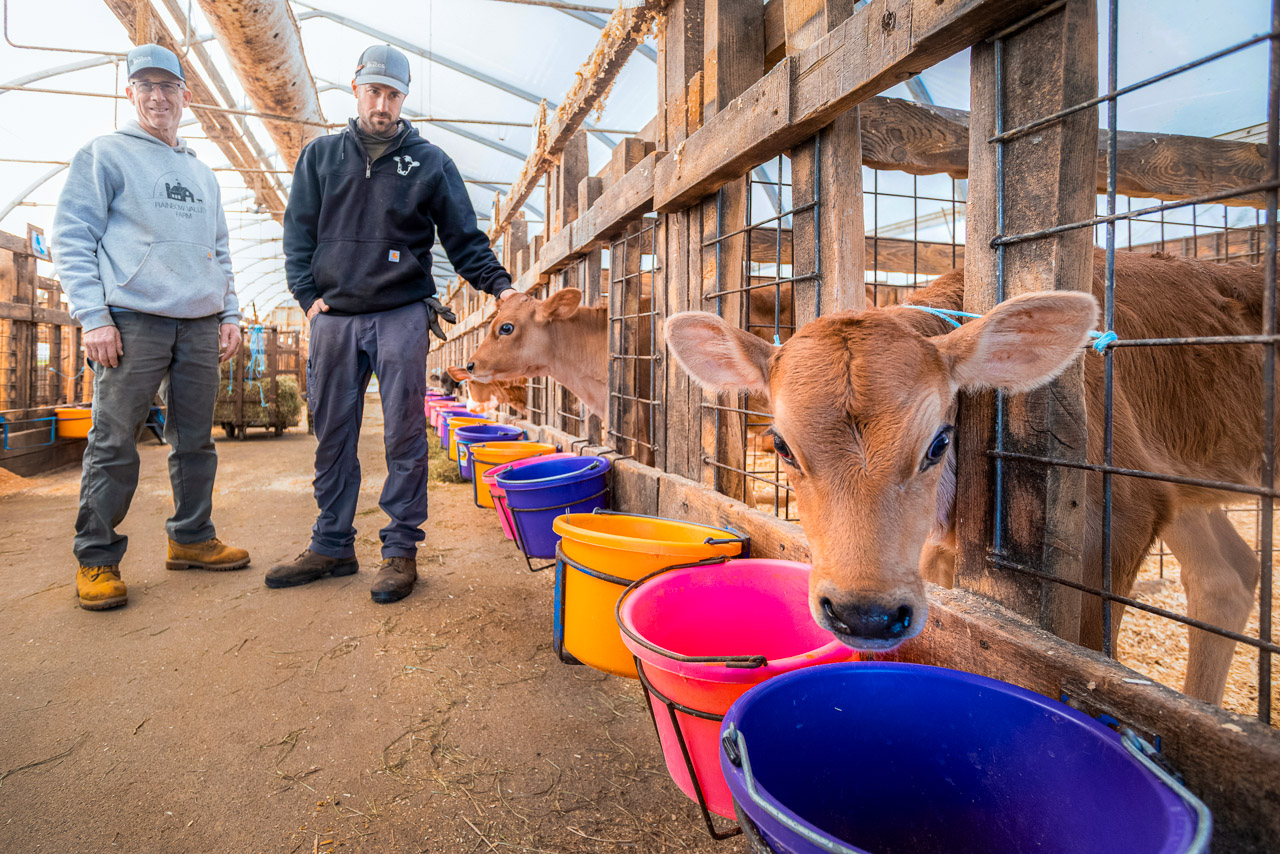
In the Kennebec County town of Sidney, the eighth and ninth generations of the Bragg family run Rainbow Valley Farm. The organic dairy farm on about 750 acres, mostly leased, has around 380 animals.
The farm produces 9,000 to 10,000 pounds of milk per day and has up to 14 full- and part-time employees, depending on the season. At any given time, as many as 10 family members work on the farm.
Jeff Bragg, who took over the farm from his parents, Harland and Shirley, has modernized the operation with improvements and projects that include construction of a heifer barn in 2000, installation of a large 100-foot-by 100-foot solid manure pit, transition to organic farming in 2004 and construction of a new parlor and holding area to enhance milking efficiency and cow comfort.
The farm uses a rotational stocking management for its milking herd. Milking cows spend about 12 hours per day in the pasture on average, and up to 16 hours at the beginning of the grazing season, depending on grass availability. Most heifers are also outside on pasture for six months or more each year. The cows’ diet is supplemented inside the barn with a mixed ration of grass silage.
Jeff’s son Jake returned to the farm after serving in the Air Force from 2003 to 2015 as a helicopter flight engineer and a C-130 navigator. Jake’s wife Jillian spends much of her time homeschooling, but she enjoys getting to milk at least a couple times each month and helping out with other jobs.
The farm has a community focus. It sells meat and milk at their farm store as well as in a few other local markets. The family hosts events and tours throughout the year. The biggest annual event is Pasture Day, where dozens of adults and kids join the Braggs in celebrating the cows’ first time going out to pasture for the year. Jeff Bragg runs an organic compost business and has hosted tours and schools and works routinely with Maine Compost School, founded in 1997 to provide specialty education around composting basics.
Earlier this year, the farm hosted a one-time “cow spa” presented by New Hampshire dairy company and yogurt maker Stonyfield Farm Inc., a buyer from the farm. The four-week spa, two days per week, featured calf cuddles and other activities.
New revenue streams
The family continues its modernization agenda, including an expansion of the milk room to add a second tank and a kitchen for on-farm milk processing for raw milk, cream and low-temp pasteurized whole milk, along with a more efficient bottling operation that will allow the farm to wholesale more milk.
A long-term dream is to offer housing to interested young farm employees to help with the rising cost of home ownership.
“It’s pretty interesting right now trying to get all the other farm tasks done and also run the construction,” Jake Bragg wryly says.
The timing is uncertain, but eventually, being able to offer cream for retail sales will provide another important revenue stream.
“The reality is that if you just have one source of income, you’re probably not setting yourself up for any sort of flexibility for any economic lows that come your way,” says Bragg. “So the point of expansion now is not only to establish a name and a brand and to be able to produce a product; it’s also for the future.”
Changing times
The industry has seen a fair amount of change through the generations.
“No longer can you farm 20 or 30 cows and make a living and pass the farm to the next generation,” says Bragg. “This is anecdotal, but my guess is you have to have 75 cows on a farm to be sustainable for one generation — and about 150 cows to be able to have a two-generation farm.”
A bigger herd doesn’t necessarily mean more hiring. Instead, farmers look to improve management protocols, infrastructure, technology, revenue and savings.
Farmers keep their eyes open for additional revenue and savings. The Braggs’ farm, for example, benefits from additional income from Jeff Bragg’s compost business and his skills as a welder and fabricator.
“He’s an incredible fabricator and designer and can build truck bodies and save us tens of thousands of dollars,” says Jake. “I try to be extremely productive with our animals, so we can run very efficiently, all the while creating a better place for our employees and community. It’s my goal that all the employees be proud of what they’re doing and to have the support of our community.”
As a voice for the next generation of farmers, Carmen Fisher engages with state officials to support farm stabilization programs while educating the public on where their food comes from.
“Maine has lost a third of its dairy farms,” Fisher says. “It’s a pretty profound loss. It’s not because someone wakes up and says, ‘I don’t want to do this anymore.’ It’s because it’s not feasible anymore. A lot of the younger generation wants to do it, but it’s not financially viable for them.”
Says Alden Fisher, “We have to be careful. You have to keep your farming simple. You have to be sensible in how you spend your money.”
