Already a Subscriber? Log in
Get Instant Access to This Article
Subscribe to Mainebiz and get immediate access to all of our subscriber-only content and much more.
- Critical Maine business news updated daily.
- Immediate access to all subscriber-only content on our website.
- Bi-weekly print or digital editions of our award-winning publication.
- Special bonus issues like the Mainebiz Book of Lists.
- Exclusive ticket prize draws for our in-person events.
Click here to purchase a paywall bypass link for this article
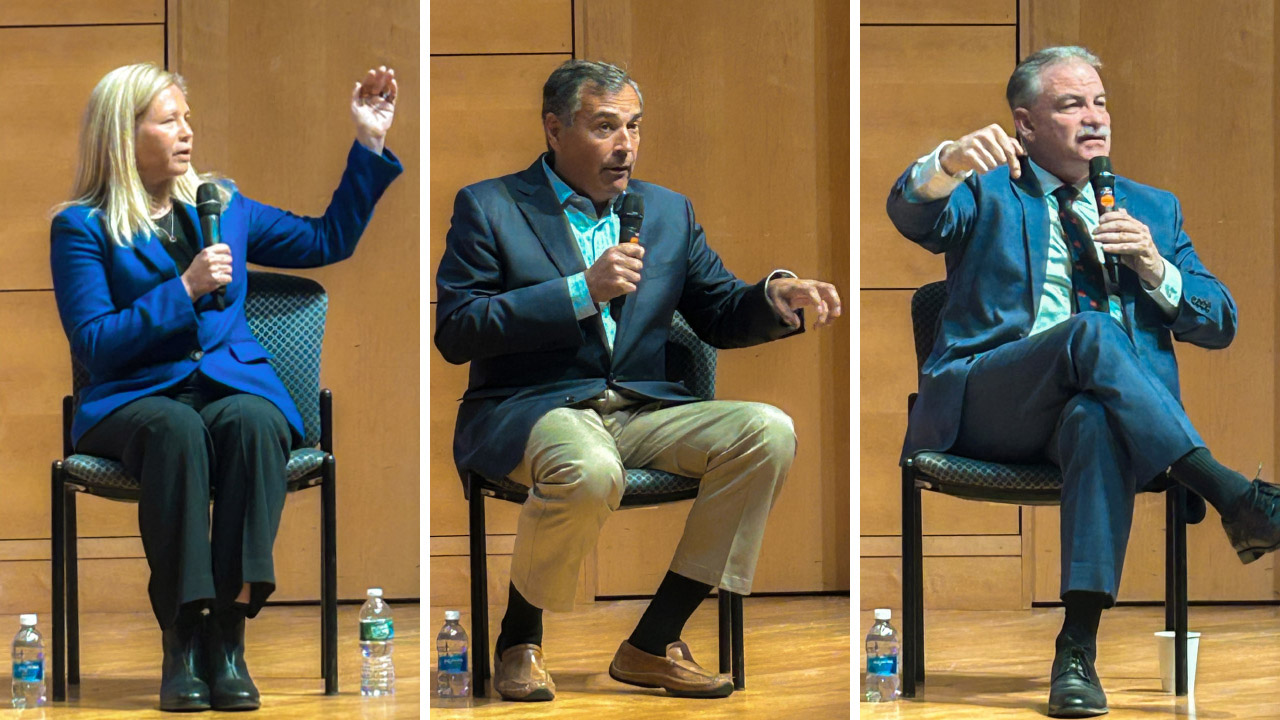
The three candidates running to become Maine’s next governor laid out competing approaches to challenges from housing affordability to state budget priorities and working with — and standing up to — the federal government.
All three were interviewed on stage separately — but asked the same questions — at the last edition of the Portland Regional Chamber of Commerce Eggs & Issues forum before Election Day, which will be Tuesday, Nov. 3.
Here are some takeaways from the event, held at the University of Southern Maine Portland campus.
Housing
Independent Rick Bennett, a former Republican who now serves as an independent state senator representing Oxford, said he would revive factory-built housing to ease the statewide supply shortage.
He also said he would conduct a “statewide bottleneck audit to knock down barriers at the state level, and then maybe at the local level, to speed up production, to speed up the approval process and actually treat this as the crisis it is.”
Republican Bobby Charles called for rolling back regulations as well as encouraging the construction of pre-fab and modular housing.
“We don’t have to reinvent the wheel,” he said. “We know what success looks like, because we were doing it 25 years ago.”
Democrat Hannah Pingree said she would invest $100 million a year on housing production, ranging from rural rentals for workforce purposes to affordable homeownership options.
“If we don’t focus on production, then nothing else works,” she said.
Budget priorities
Criticizing President Donald Trump’s tariffs and war in Iran along with cuts to the health care system for creating “headwinds” in Maine, Pingree said that the next state administration will face difficult decisions amid a requirement for the state to pass a balanced budget by June 30.
“I actually believe there is an opportunity to work across the aisle,” she said, noting that her priorities will be housing, health care, education and economic development.
“I think you can invest in those things while also doing things like ensuring that people in the state of Maine can pay their property taxes," she added.
Calling health care, education and economic development “all part of a compound solution to a compound problem,” Charles said he would offer incentives to doctors, nurses and clinicians to stay in Maine by forgiving their educational loans at the front end and put an educator in charge of the state’s education department.
“I want a master teacher in charge. I don’t want administrators running the show,” he said.
If elected Maine's next governor, Bennett said his administration would scrutinize the state’s current services budget and work with both parties to get it passed.
“It’s a heavy lift, but we can do it,” he said.
Relations with Washington
Blaming the federal government for making Maine’s relationship with Canada more difficult, Charles said he would work on securing a “carve-out” with U.S. Sen. Susan Collins, R-Maine, who is running for reelection to a sixth term this November.
He also pledged to repair what he called the state’s “miserable” relationship with the federal government.
“We have to have a strong working relationship with the federal government,” he said, “but it starts right here.”
While promising to continue Maine's tradition of setting aside partisan issues when the state's interests are at stake, Bennett said the state is too dependent on the federal government.
“We need to wean ourselves off of that and become more self-reliant," Bennett said.
To protect Maine’s interests with its biggest trading partner, Bennett said he would appoint an ambassador to represent the state on the ground in Canada. He also said his administration would conduct “tariff triage” to help businesses affected by import taxes.
Taking a tougher stance against Trump, Pingree said, “Maine people want a strong leader who can stand up for this president, when he is especially pushing back on the rights of many people.”
But the former Maine House speaker underscored that she is not running for governor to become some kind of national hero.
“It’s not about picking a fight with Washington," she said. "It is about standing up for Maine people and our rights, but also finding collaborative solutions when possible."
Around 200 people attended the forum.
"My biggest takeaway from the forum is that we have an incredibly important decision to make on Nov. 3," Quincy Hentzel, president and CEO of the Portland Regional Chamber of Commerce, told Mainebiz afterwards.
"Maine is facing significant challenges, and we undoubtedly need a leader who is willing to bring new, bold ideas to the table and tackle those challenges head-on — especially in the areas of housing and workforce development," she added.
