Already a Subscriber? Log in
Get Instant Access to This Article
Subscribe to Mainebiz and get immediate access to all of our subscriber-only content and much more.
- Critical Maine business news updated daily.
- Immediate access to all subscriber-only content on our website.
- Bi-weekly print or digital editions of our award-winning publication.
- Special bonus issues like the Mainebiz Book of Lists.
- Exclusive ticket prize draws for our in-person events.
Click here to purchase a paywall bypass link for this article
Electric boats are gaining traction in Maine. This year alone, Lyman-Morse launched an electric-powered passenger vessel and Casco Bay kelp farmer Nathan Johnson began a pilot project with a French electric propulsion maker and Island Institute to test electric propulsion on a workboat.
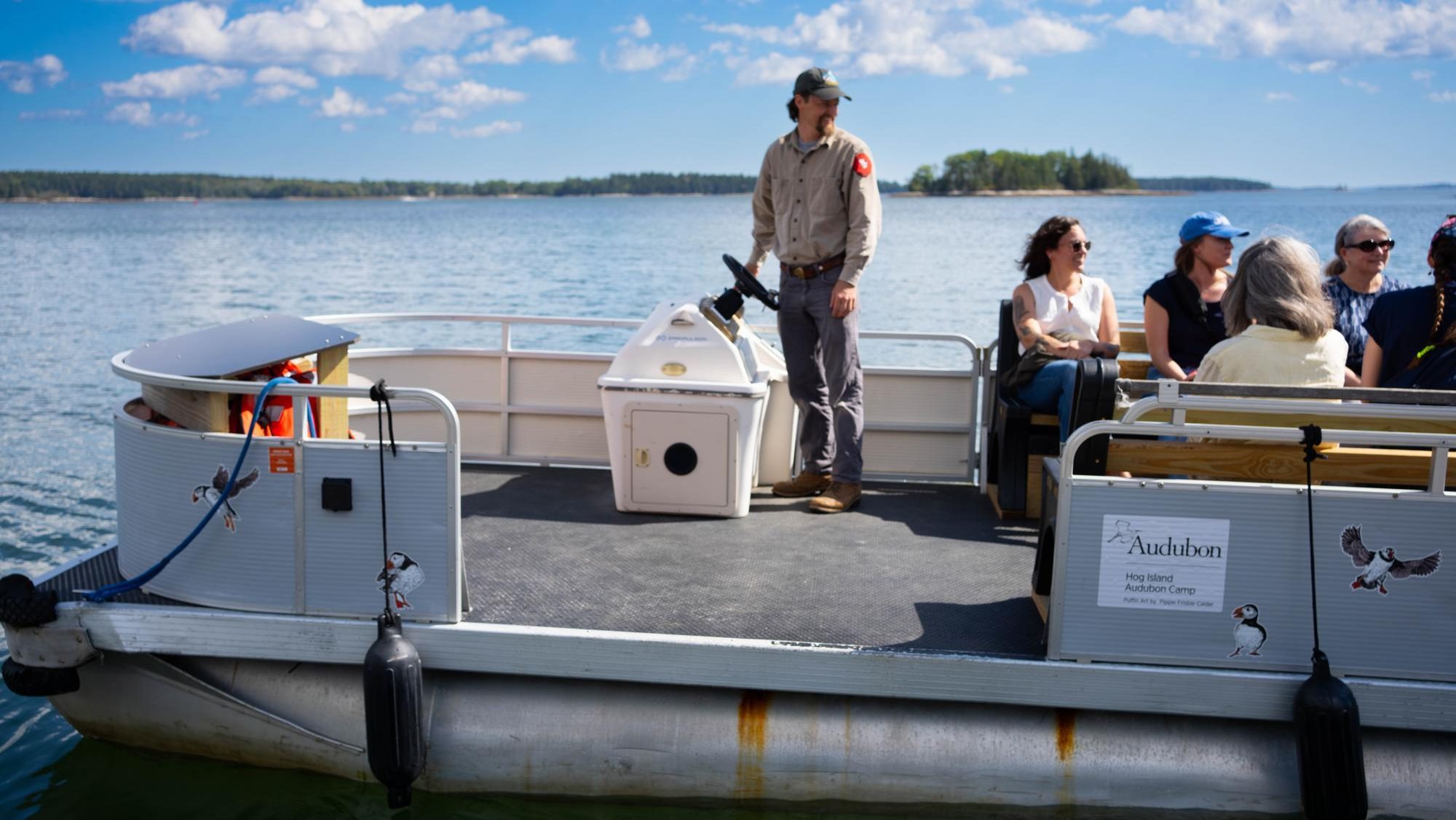
Now on Maine's midcoast, the National Audubon Society conservation nonprofit has launched its first fully electric passenger boat at its residential educational camp facility, Hog Island, off midcoast Maine in Muscongus Bay. Hog Island is part of the Lincoln County town of Bremen.
Electric propulsion from China
Audubon's Seabird Institute, Rockland community development nonprofit Island Institute and ePropulsion, through its North American distributor Mack Boring & Parts Co. in Somerset, N.J., teamed up to launch the boat.
Based in China, ePropulsion is a manufacturer of electric marine propulsion systems established in 2012 and expanded into the U.S. in 2023.
The Seabird Institute conducts research and conservation work on seabirds and the marine ecosystem.
Refurbished pontoon
Audubon’s refurbished pontoon boat is powered by a 20-kilowatt ePropulsion electric outboard, to transport people and supplies between the mainland and Hog Island throughout the camp season.
The vessel is the first fully electric passenger boat in National Audubon's fleet, designed to transport people and supplies between the mainland, Hog Island and other coastal research operations from April through October. On busy operational days, the boat could make more than 25 round trips between Hog Island and the mainland.
“Hog Island is becoming Audubon's model for understanding environmental change and developing adaptation and resilience solutions,” said Laurie Bragg, center director for Audubon’s Seabird Institute. “This investment from Island Institute and ePropulsion not only allows us to reduce our footprint, but it provides an opportunity to educate campers from across the country about coastal resilience.”
Established in 1936, the 330-acre Hog Island Audubon Camp is the society’s only residential camp facility, bringing together hundreds of campers, volunteers, researchers and other visitors each year to learn about conservation, ornithology, ecology and the natural world.
Cost savings
Advantages of electric propulsion include being significantly quieter than a conventional gasoline-powered outboard, reducing engine noise in an area used for wildlife observation and research, according to a news release. The vessel is also expected to save thousands of dollars in gasoline and future maintenance costs and reduce carbon emissions.
The Island Institute has worked for more than five years alongside commercial boat operators, with a goal to prove that electric propulsion can hold up on a working waterfront.
“Hog Island gives us a chance to bring that same work into a new setting and show just how many ways this technology can support coastal operations,” said Lia Morris, Island Institute’s senior community development officer.
Testing electric
Since 2020, Island Institute has helped lead Maine’s transition to marine electrification, working with commercial operators, technology companies and other partners to test and put electric propulsion to work on the water.
The Hog Island project expands that work into a new coastal application.
Island Institute’s electric boat initiative receives funding from Chicago-based investment and philanthropy platform Builders Vision, Maine Technology Institute, the state of Maine and corporate sponsors.
