Already a Subscriber? Log in
Get Instant Access to This Article
Subscribe to Mainebiz and get immediate access to all of our subscriber-only content and much more.
- Critical Maine business news updated daily.
- Immediate access to all subscriber-only content on our website.
- Bi-weekly print or digital editions of our award-winning publication.
- Special bonus issues like the Mainebiz Book of Lists.
- Exclusive ticket prize draws for our in-person events.
Click here to purchase a paywall bypass link for this article
The high-octane Turkish coffee — slow-brewed over hot sand in an elegant small copper pot — was a bit strong for the customer’s liking, but he’ll be back.
“It’s probably not something I would get again,” Adam Martins says on opening day at Portland’s newest downtown café. “I like my Americano.”
Martins, set to start a job as a physician’s assistant, was among the very first customers at Y%F Coffee, owned by Yousif Albadri across from the Portland Museum of Art in a 1920 red-brick office building that had been vacant for more than 15 years. Since opening its doors on March 20, the sprawling corner venue has sprung back to life behind floor-to-ceiling picture windows. Bathed in warm reds and forest greens, the 80-seat mocha-to-mojitos gathering spot is opposite the Flatiron Coffee Bar (itself in a former Starbucks location).
Both are among a handful of new businesses filling vacant storefronts in a part of town that’s struggled with drug use, theft, graffiti and homelessness. Lately it’s been getting more attention from the city, law enforcement and nonprofits to tackle crime, remove trash and connect those in need with food, clothing and other essential supports. As the city seeks to revitalize the downtown Arts District via business loans and a requirement as of April 1 that property owners devote window space to art installations or pay a fine, leasing demand is starting to pick up.
“I have noticed a little bit of resurgence,” says Thomas Moulton, a broker and partner with the Dunham Group, a Portland-based commercial real estate firm. Keeping the momentum, he says, requires greater collaboration between the business community and the city to make the area cleaner and safer. He’s also an advocate for free city parking but admits that’s probably not realistic given municipal budget constraints.
To spur sustainable growth and attract long-term tenants downtown, colleague Frank O’Connor would like to see the city drop impact fees for new developments, streamline permits and step up efforts to address the homeless problem. That’s a tall order for a city of 70,000 with a compact center where local tensions can loom large.
Downtown cleanup and safety measures
As executive director of Portland Downtown, a nonprofit underwritten by property owners, Cary Tyson keeps daily tabs on local business activity. As soon as a new place opens, he drops by to introduce himself and his organization, like he did at Y%F Coffee on opening day.
“We’ve made a concerted effort — a lot of outreach, a lot of PR, working with Realtors and property owners — and I think we’re seeing the fruits of that labor,” Tyson says before conferring with two “Downtown Ambassadors” on their way to pick up chairs for public use at Congress Square Park.
The workers are part of an eight-member crew employed since last summer to handle a range of duties from light cleaning and graffiti removal to conducting business and merchant checks. With four new hires on the way, they’ve completed more than 18,000 tasks to date; that includes 7,030 trash removals and 4,000-plus graffiti cleanups.
Downtown Ambassadors also clean up and set up a distribution area inside a parking lot along High Street where unhoused individuals can get food, clothing and other supports in a city-managed undertaking assisted by nonprofits and a local church.
“This is a really collaborative effort where all partners work together to reduce food insecurity, connect clients to shelter and housing, and be good community partners,” says Danielle Smaha, a spokeswoman for Preble Street, a Portland social services nonprofit.
Law enforcement and martial arts
Law enforcement efforts to clamp down on theft are also yielding results. Portland Police Department data provided to Mainebiz for a 0.6-mile stretch of Congress Street show that while the number of calls for service in 2026 is higher than a year ago, those related to theft are down by about a third. Police spokesman Brad Nadeau attributes the decline to “special attention” from police after last year’s spike.
Tyson says that having a new community policing office near Monument Square as well as uniformed, non-law enforcement constables will make the neighborhood safer, along with the planned move of a longtime Portland martial arts school closer to Monument Square.
“Nothing makes downtown safer than ninjas,” Tyson quips.
Portland Kung Fu, currently housed above the State Theatre, is preparing to relocate to the former Golden Lotus Restaurant at 511 Monument Square.
David Bearce, a Bruce Lee fan who founded the school in 2014, plans to sign a 10-year-lease on the bigger, ground-floor “dream location” and open by July.
“It’s very centrally located, right in the heart of Portland downtown — the right size to run a robust program with a lot of people working out at the same time,” he says.
Collectibles store keeping options open
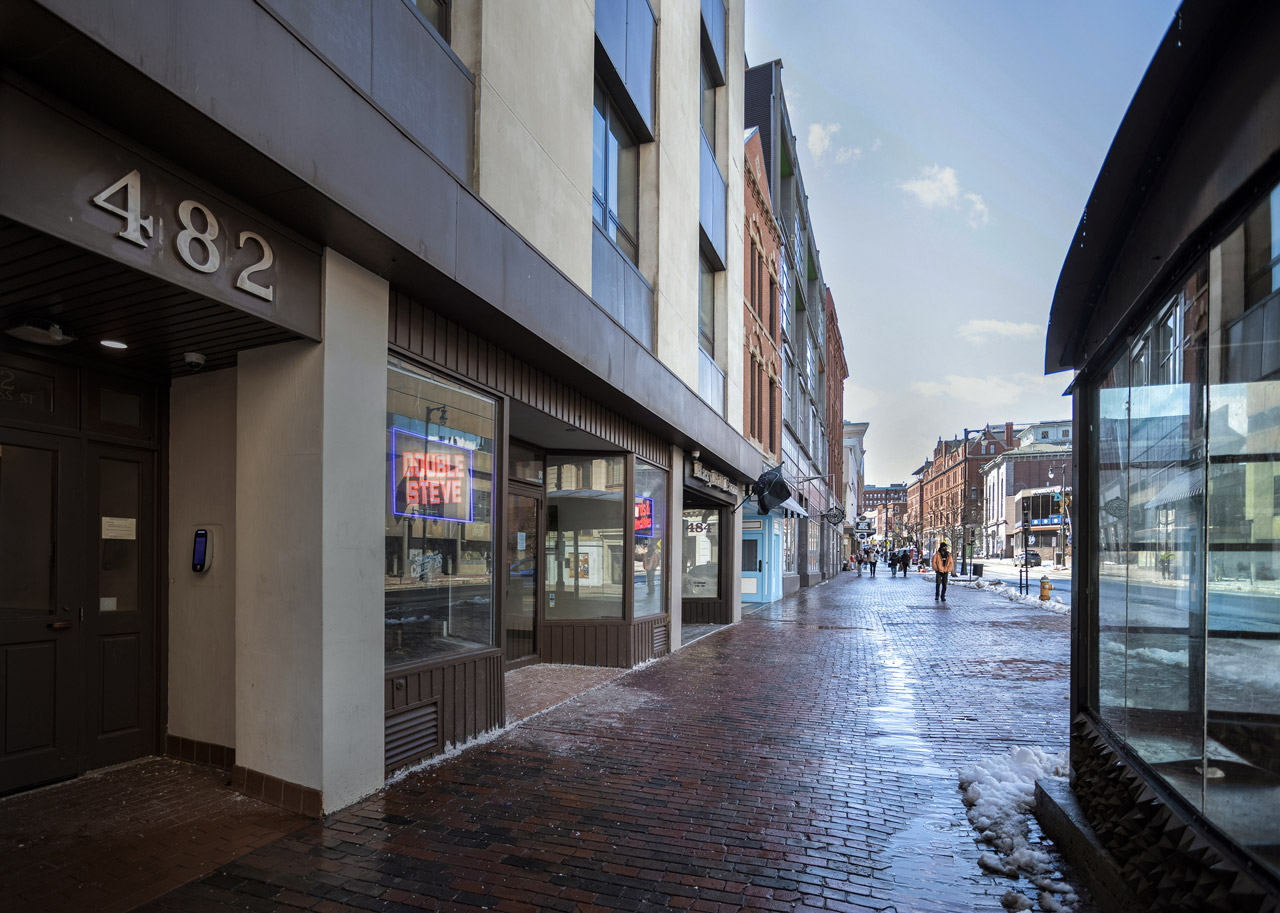
For Double Steve Cards & Collectibles, a store selling trading cards that opened in early March, being located near Monument Square has been a mixed blessing.
The store, open only on weekends, is a side hustle for Steve Brown, who oversees partnerships and ticketing for the Portland Hearts of Pine pro soccer team, and Steve Sawyer, a Portland-based executive with Worcester, Mass.-based Cornerstone Engineering Services.
The longtime collectors are paying $2,400 in monthly rent to run a store that’s only open on weekends — Friday night and all day Saturday and Sunday.
They signed a three-year lease in December, taking their trade-show hobby to a permanent home for stacks of cards featuring pro athletes from legends of yesteryear to current fan favorites, Pokémon characters and game cards for “Magic: The Gathering.”
Cards range from $1 bargains to a top-rated memento of Los Angeles Dodgers star Shohei Ohtani from a special Major League Baseball/Garbage Pail Kids crossover priced at $8,750.
“We wanted to be somewhere with foot traffic, especially tourists, and this was one of the few spots that fit what we were looking for,” says Brown.
Sawyer says that while business is going better than expected, it’s also been challenging.
One Saturday morning as customers browse cards stacked in narrow pull-out drawers, Brown admits to a rough start at the location, where a fire broke out at the bus stop outside on opening day and another time someone “put his butt cheeks on my window.” More concerned about drug use and discarded needles in the area, Brown says he’s exploring how to better secure the front entrance, seeking to make a go of the nostalgia-inspired venture via a mix of in-store and online sales and participation in livestreamed auctions. Eventually, the plan is to host auctions, tournaments and other events and possibly install a bar in the back if zoning allows.
But they’re keeping their options open if the drug problem and safety concerns persist.
“A lot of our business is geared toward families and kids, and you don’t want them walking past people doing drugs right outside,” says Brown, who lives in the neighborhood. “If that stuff’s not going to change, we’re going to find a different spot.”
From ‘insane optimism’ to ‘making it work’
On the other side of the street, Supper Club Cocktail Lounge is a new gastropub in the former home of the Guitar Grave pawn shop that left the neighborhood in 2019.
Though the founders had looked at other locations, “we didn’t really want to be in the Old Port and want to be more part of the city,” says Jake Bosma, a co-owner and general manager.
In a city known for its culinary offerings, Supper Club aims to stand out with “hearty, but approachable comfort food” from pork and polenta to coconut poached hake and an extensive bar menu. Cocktails include a citrus-accented Wisconsin Old Fashioned. Close to City Hall and Merrill Auditorium, Supper Club is open five nights a week and can accommodate around 85 seated customers. Its owners — six in total — signed a lease for five years.
“It’s a commitment, but five years goes by quick,” Bosma says with a snap of his fingers. “You also have to have some insane optimism.” Though mum about longer-term plans, he says the group would “love to keep operating in our current space well after our five-year lease.”
A few doors down at 417 Congress St., the owners of Nash & Co.—an arts and crafts store and evolving community art hub awash in brightly colored stained-glass objects, art prints, coffee table books and whimsical toys — opted for a three-year lease.
Still working on the buildout a few months after opening his doors, Jaime Nash says he finds the neighborhood more affordable than Commercial Street along the waterfront.
“For a person to start something that’s never existed, you kind of have to go where it’s a little bit rougher around the edges,” the former advertising creative director says on a quiet early afternoon in the store, where he’s still working on bathroom and basement renovations. “You’ve got to make it work and build it over time.”
Unsure how that will go, Nash says he didn’t want to get locked into a longer lease: “Will it work? I don’t know,” he says. “It’s never been done before, so we’re going to find out.”
At 1,600 square feet, Nash & Co. is a fraction of the size of a 28,000-square-foot space formerly occupied by Renys, a family-owned discount retailer that ended its 15-year Congress Street run in late December, leaving a dusty mannequin torso in the window. The storefront has been vacant ever since, prompting Boulos Co. broker Cameron Foster to reduce the listed sales price by 30% to $2.975 million and the listed lease rate by 21% to $7.50 per square foot.
Musing on the site’s next chapter, Nash says he’d like to see it go to a local tenant or group of independent vendors.
“I’d hate to see some big corporate chain come in there,” he says.
Bold aspirations
Even with Renys gone, the number of storefront vacancies in the three-block stretch of Congress Street between Monument Square and the Portland Museum of Art is about half the number Mainebiz counted in July.
As the museum embarks on a $100 million expansion, Quincy Hentzel, president and CEO of the Portland Regional Chamber of Commerce, believes it could be a turning point for the city.
The art museum project “has the potential to draw more visitors, increase foot traffic, support surrounding businesses and contribute to a more active, vibrant corridor,” she says.
Across the street from the museum in the same building as Y%F Coffee, Stacy Mitchell has opened Bold Magazine Shop, a small vendor stocked with around 175 titles. They span local magazines — one crafted entirely in graphite pencil, another wrapped in colored strands of thin yarn — to glossy fashion tomes with coffee-table cachet.
“I am so thrilled with the location,” Mitchell says in her 800-square-foot store, a stark contrast to the bustling coffee shop next door. “We’re part of a really nice cluster of places where people are spending time.”
At the other end of Congress Street, near Monument Square, developer Jim Brady is proceeding with plans to transform an early 20th century bank building into a high-end hotel that’s been undergoing site work since October. It’s on track to open by 2027, Brady says.
While much of Portland’s development has shifted over the past 15 years a few blocks away to the waterfront, Brady is convinced that the Congress Street corridor is poised for a comeback: “I believe it has hit the bottom and is on the way back up,” he says.
