Already a Subscriber? Log in
Get Instant Access to This Article
Subscribe to Mainebiz and get immediate access to all of our subscriber-only content and much more.
- Critical Maine business news updated daily.
- Immediate access to all subscriber-only content on our website.
- Bi-weekly print or digital editions of our award-winning publication.
- Special bonus issues like the Mainebiz Book of Lists.
- Exclusive ticket prize draws for our in-person events.
Click here to purchase a paywall bypass link for this article
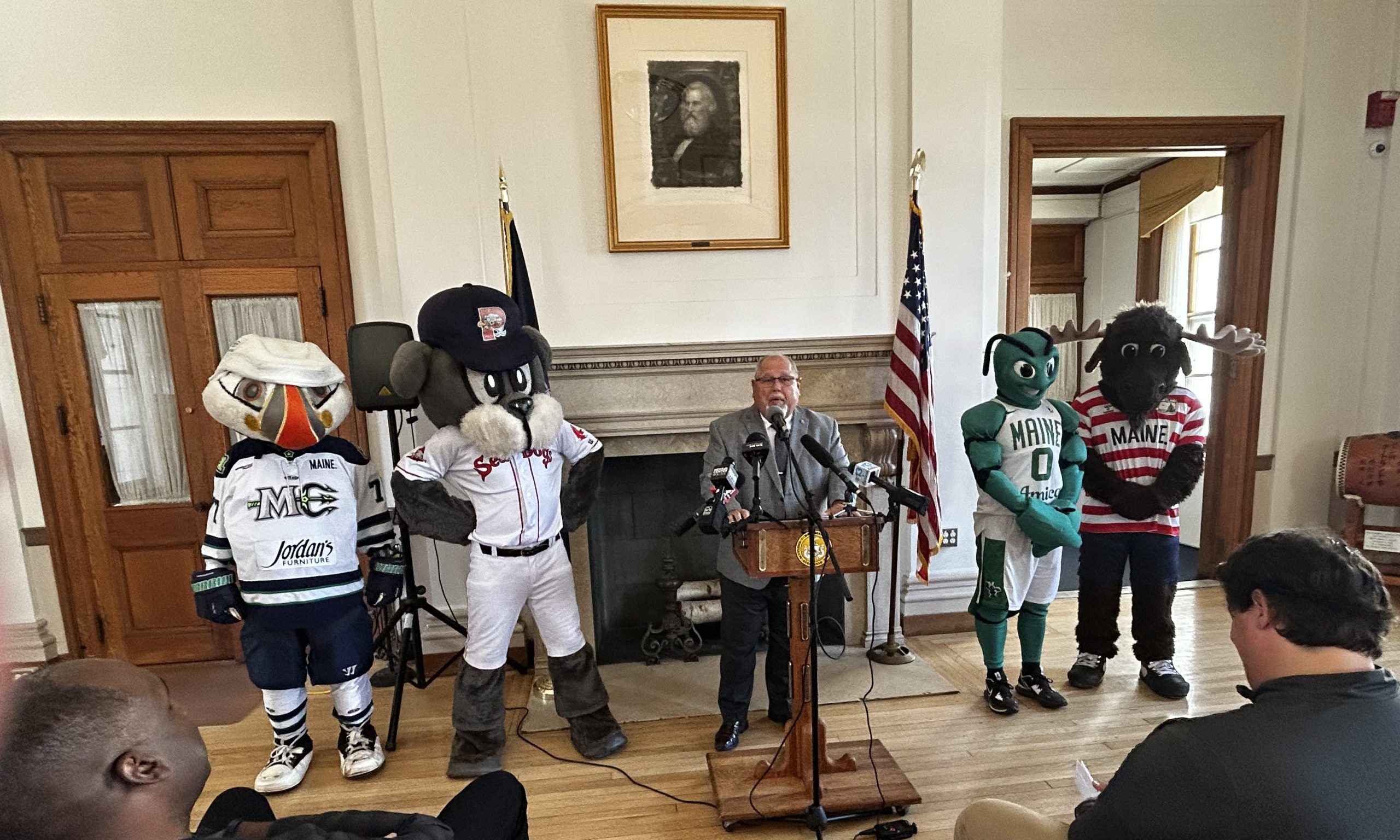
Joined by Slugger the Sea Dog and other sports mascots at Portland City Hall, Mayor Mark Dion unveiled a study showing the statewide impact of the four minor league teams based in Maine's largest city.
“These teams generate over $110 million annually to our economy, as well as creating over 900 jobs, not just here in Portland, but across the state," Dion said, flanked by a furry foursome of team ambassadors.
“It’s not just investment on their part in our city,” he said, “but it’s a commitment to the state of Maine.”
Speaking at a Wednesday morning press conference, Dion cited figures from a study conducted for the city by researchers at the University of Southern Maine.
Researchers looked at multiple factors to measure economic impact, including annual team operations as well as spending by visitors coming from 50 or more miles away to attend games, annual spending by visiting teams and team investments in capital improvements.
The report also examines the community impact of the Portland Sea Dogs baseball team, the Maine Mariners hockey team, the Maine Celtics hoopsters and the Portland Hearts of Pine soccer squad, as measured by donated tickets, charitable contributions, and business and community partnerships.
'Bright future ahead'
Reflecting on the nearly 20 years since the founding of the Maine Red Claws, which were rebranded as the Maine Celtics in 2021, Maine Celtics President Dajuan Eubanks said community partnership “is the root and the base of all of our organizations.”
“If it wasn't for our community, and our partners and more importantly the fans, we wouldn't be standing here in the position that we're in and more importantly, we wouldn't have the bright future ahead of us, too."
Eubanks also said he is honored “to say that Portland, Maine, is our home. But it's not just Portland, it's Maine altogether.”
USM researchers started their work on the study in January to help city officials quantify Portland’s sports cachet in future discussions about zoning and investments. In 2024, the city was named by Sports Business Journal as the nation’s No. 1 for minor league sports.
Portland slipped to No. 2 in the most recent barometer after being displaced by Greenville-Spartanburg, S.C.
Financing, zoning
In response to a question from Mainebiz about how the city plans to support Maine’s pro sports teams going forward, Dion said, “We do what we can in the economic development space.
“Where financing is needed, we can provide bridge loans. We can work hard to make sure zoning makes sense and is rapid enough, because businesses make decisions in a timeline that is attached to cost,” he said. “If we can work in those spheres, it’s helpful.”
The findings were released as the Hearts of Pine proceed with plans to build a privately funded $50 million stadium on industrial waterfront property and launch a pre-professional women’s squad in 2027.
The stadium plan, unveiled last month, is set to be discussed at a Planning Board workshop next Tuesday.
