Already a Subscriber? Log in
Get Instant Access to This Article
Subscribe to Mainebiz and get immediate access to all of our subscriber-only content and much more.
- Critical Maine business news updated daily.
- Immediate access to all subscriber-only content on our website.
- Bi-weekly print or digital editions of our award-winning publication.
- Special bonus issues like the Mainebiz Book of Lists.
- Exclusive ticket prize draws for our in-person events.
Click here to purchase a paywall bypass link for this article
For some Maine makers of premium products, premium prices are part of the business model. Examples range from guitars that cost more than $10,000 to $200 tote bags.
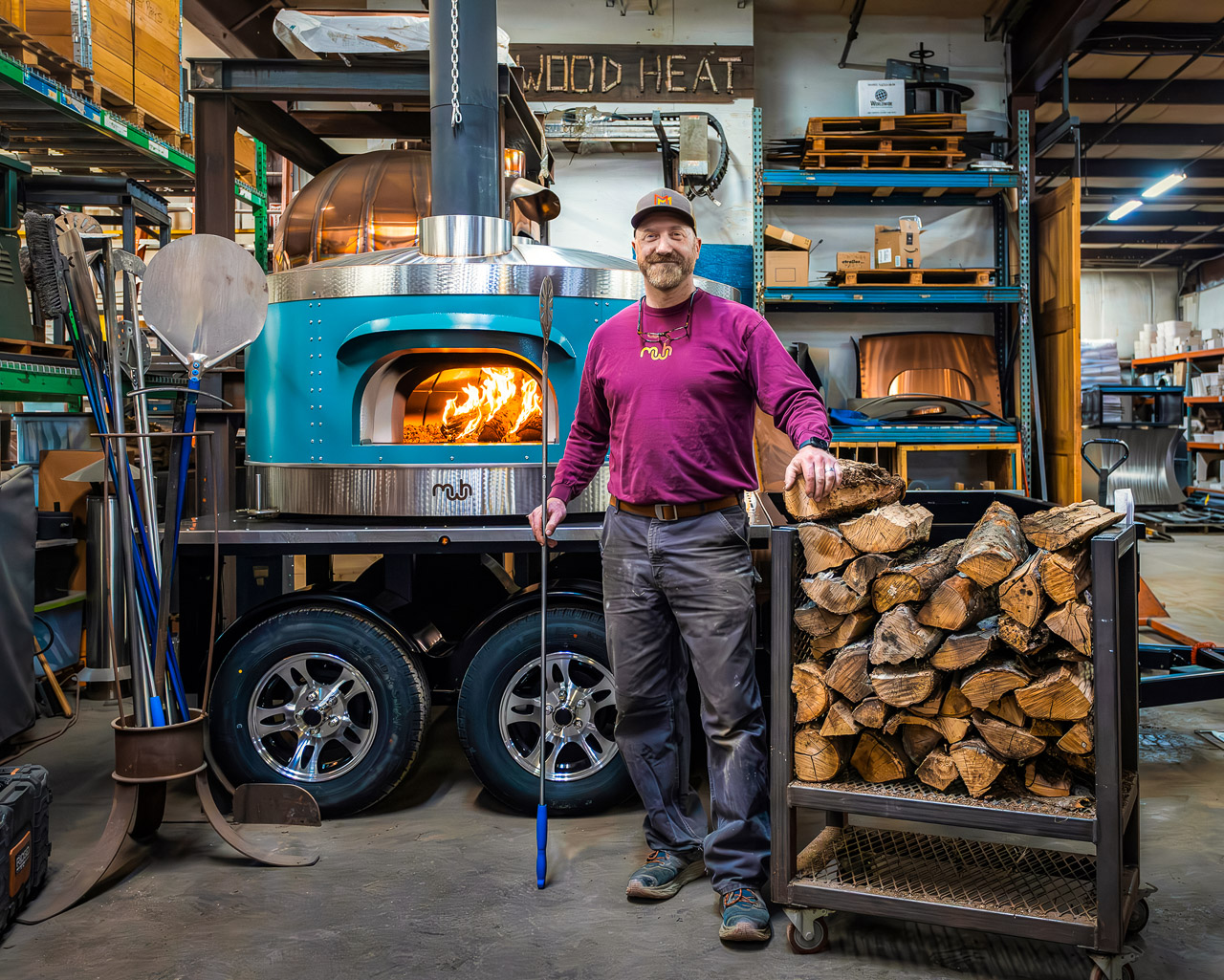
For Scott Barden, co-founder of Skowhegan-based Maine Oven Craft, the formula for staying competitive as a manufacturer of premium products in a market filled with mass-produced, lower-priced alternatives is relatively simple.
“We’re designing something that we know is going to exceed most people’s budgets, but will always exceed people’s expectations,” says Barden, whose company produces wood-fired ovens for commercial and personal use.
The concept may sound straightforward, but it is a significant challenge when the company’s products can cost $10,000 to $30,000 more than competitors’ offerings. Maine Oven Craft’s least expensive model costs about $14,000, while a commercial oven with on-site installation can cost as much as $70,000.
At those prices, the promise to go above and beyond means more than delivering a premium product.
For Maine Oven Craft and other Maine-based manufacturers of high-end products, business depends not only on product quality but also on personal relationships and connections with customers.
“We still try to make it really clear to clients that we’re really about the connection with them,” says Barden.
“Yes, there’s a financial transaction happening,” he continued, “but at the end of the day, what makes us different is that we’re not just a name. We’re people. We’re wanting to be available, and we’re wanting to create a memorable experience.”
Brand cachet
Beth Greenlaw, co-founder and CEO of Portland-based Sea Bags, says that the values that continue to drive the company’s cachet were embedded into its founding.
Greenlaw started the company 20 years ago with three cornerstones in mind: making and sourcing products within the United States, and in Maine whenever possible; environmental sustainability; and giving back to the community.
Sea Bags’ line of tote bags and accessories is made from recycled sailcloth that would otherwise head to landfills, which Laura Hnatow, vice president of marketing and e-commerce at Sea Bags, describes as a key draw and marketing angle.
“It’s not that it’s a product that Sea Bags added sustainability to,” says Hnatow. “Sustainability is the product.”
Likewise, she adds, “It’s not a product that they decided to bring on shore; it was an on-shore product. And that storytelling really creates this brand following, brand loyalty that’s really easy to talk about in places like social media, where customers can start to spread the word for us as well.”
Sustainability isn’t the only reason customers pay the premium, Greenlaw says, “but it’s a reason that they feel good about it.”
Garden products with an emotional tie
Coast of Maine Organic Products, a Portland-based company that produces bagged gardening soil and compost, attracts a similar eco-conscious customer base.
CEO Erik Drake says that company founders Carlos and Jean Quijano noticed “a couple of things in Maine where they thought that there was a problem that needed a solution ... and what that problem was, was that there was excess waste from the seafood industry.”
Lobster, oyster and crab shells and other seafood waste were regularly ending up in landfills, much like the sailcloth recycled by Sea Bags.
Today, some of that seafood waste is funnelled into Coast of Maine’s manufacturing line.
Premium manufacturers say their values also hold people-focused, customer-facing attitudes within their values.
“We care about our end consumer and we want them to be successful,” says Drake. “We like to say gardening is a very emotional experience, and unfortunately for a lot of people, it [evokes] a negative emotion.
“But by giving them better soil that puts them in a better position for their products, for their plants and produce and so forth to grow, they’re successful,” he adds, “and that’s what makes us successful.”
Instrumental change
While premium manufacturers can boast big-name customers and reputations for exceptional quality, achieving and maintaining this success isn’t without effort.
At Bourgeois Guitars in Lewiston, the most sustainable path forward was to work with a large distributor to expand into the intermediate-quality realm.
Co-founder and master luthier Dana Bourgeois started the company in the mid-1990s and has attracted big-name clients such as Vince Gill, Doc Watson and Luke Bryan.
But with the high-end guitar market slumping in the U.S. while growing internationally, the company, now headed by CEO Christopher Fleming, sold its majority share to multinational corporation Eastman Music Co.
The high-end guitars start at around $5,000 and go up to $30,000 on the luthier’s regular price list, but “the sky’s the limit” on custom orders, Bourgeois says, noting that the company has built $90,000 guitars.
The luthier will continue to manufacture hundreds of high-end guitars in Lewiston each year, but now also produces thousands of intermediate-quality instruments to be distributed across the globe.
The premium, Maine-produced instruments continue to drive the majority of Bourgeois’ business. But within a year of its launch, the intermediate quality line accounts for one-third of overall sales.
And for the foreseeable future, Bourgeois sees the co-produced line as “the real growth opportunity” for the business.
Buyers in the U.S. high-end guitar market are largely an aging demographic no longer shopping for new guitars, he says.
“Not to say that the [high-end] market is dead,” Bourgeois says, “but the growth potential won’t be there until the intermediate players sort of mature. We’re in a generational gap at the moment.”
That shift also means extra legwork to introduce the Bourgeois name to a new clientele.
“We’ve been in the boutique market for 35 years, and higher-end dealers, they know us,” Bourgeois says. “Our customers know us. And you sort of get lulled to sleep [thinking] that your customers know everything there is to know and you don’t have to do much educating.
“So we’re trying to emphasize the basics of guitars, what our build philosophy is, what our guitars sound like,” he adds.
Mass production
Premium manufacturers also contend with giant corporations with proportionately large advertising budgets.
Coast of Maine sells through independently owned garden centers and hardware stores, rather than retail giants like Lowe’s or Home Depot, Drake notes. And while customers may appreciate this focus on local, small businesses, the manufacturer’s products are still side-by-side with mass-produced, less expensive materials.
“The easiest thing for a consumer to do is just … go to a retailer and see pallets of this [mass-produced] product they had seen on TV with big signs that say they’re on sale,” Drake says, and they ”just grab the cheap bag that they’ve heard of before.”
For smaller companies like Coast of Maine, “we have to engage that consumer long enough for them not just to hear the price, not just long enough for them to remember the brand, but to learn about what makes our brand and our products, our soils, our fertilizers better,” he adds.
Sea Bags has also “done some right-sizing in the last year and a half that has forced us to really look at how well we sell and what channels we sell through,” Greenlaw says.
Value remains foundational
While customer experience, company mission and marketing play essential roles for premium manufacturers, those within the sector note that money and quality remain supreme.
These aspects have been top of mind at Sea Bags since the company’s founding, Greenlaw notes, with customers sometimes investing more than $200 into one of the company’s large tote bags.
“We tried to build something that wasn’t just a product, but something kind of iconic that would last a long time,” Greenlaw says.
“Our competition could be paying for gas in your car or groceries, so that’s what we have to be conscious of,” Greenlaw says. “There are plenty of tote bags out there, and we think ours are different and special.”
Mass producers “lean a lot into the wood products,” says Drake, “and so often, there are some soils out there that almost feel like you’re opening a bag of mulch and there’s nothing in there but ground-down wood.
“We include all of those, but then we include compost,” says Drake. “When you add compost, that living soil, it really supercharges the soil and brings it to the next level … We don’t just go with the cheaper ingredients.”
And at the end of the day, Barden notes, the money talks.
“People come in and say ... tell me about why that value is worth it for me,” Barden says, “especially if (they’re) already pinching pennies.”
“More than anything, I try to provide them with anecdotal information from our clients or put them directly in touch with clients that were in the same sort of space when they first began.”
These customers “can show them and tell them that not only was it a really solid investment because of how it performs going forward,” Barden says, “but just how quickly they were able to make their money back … with the efficiency and production potential that we build into our products.”
