Already a Subscriber? Log in
Get Instant Access to This Article
Subscribe to Mainebiz and get immediate access to all of our subscriber-only content and much more.
- Critical Maine business news updated daily.
- Immediate access to all subscriber-only content on our website.
- Bi-weekly print or digital editions of our award-winning publication.
- Special bonus issues like the Mainebiz Book of Lists.
- Exclusive ticket prize draws for our in-person events.
Click here to purchase a paywall bypass link for this article
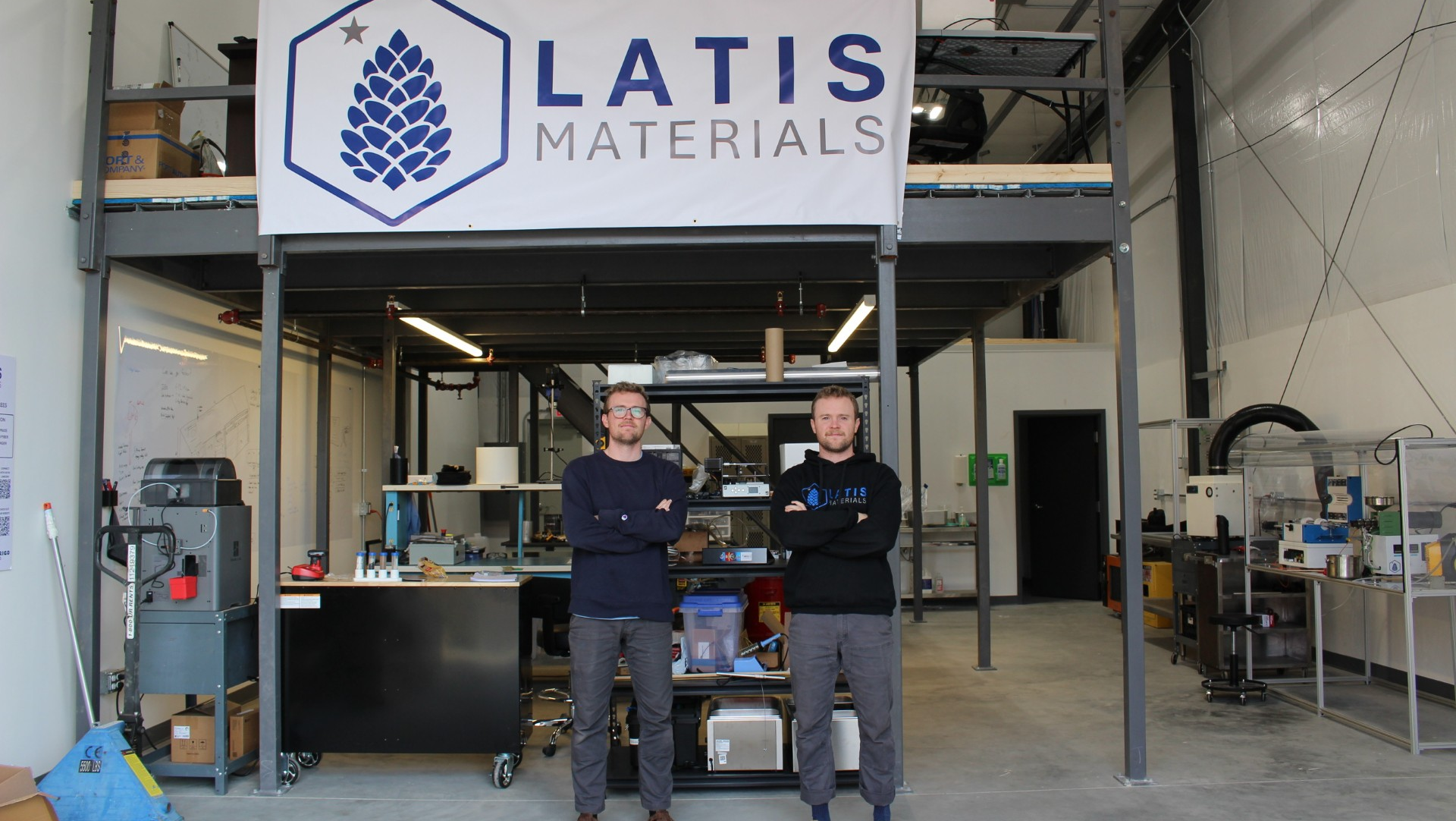
Twin brothers Aidan and Will Salisbury launched biomaterials startup Latis Materials in 2025 after completing mechanical engineering degrees at the University of Maine.
The startup uses a byproduct of paper production to create carbon fiber yarn they said matches the strength of traditional carbon fiber at a fraction of the cost, offering an affordable, lightweight option for a range of manufacturing applications.
The startup won the Emerging Business Award in last week's LaunchPad business-pitch contest and took home the $20,000 top prize in Dirigo Labs's pitch competition earlier this year. The brothers plan to use the funds to equip a small-scale manufacturing line to turn prototypes into finished products.
Mainebiz: Where is Latis Materials located?
Aidan Salisbury: Latis has ties to the Roux Institute’s Climate Tech Incubator in Portland and lab space in Brunswick.
MB: How did the concept come about?
AS: My co-founder and I first explored the idea while writing a white paper for a technical communications class at UMaine. The more we learned, the more excited we became about the opportunity: to make carbon fiber in a new way, create value from Maine’s forest products and help build advanced manufacturing jobs here in the state.
MB: You mentioned using a paper production byproduct to create carbon fiber yarn. What is the byproduct?
AS: We use a naturally occurring material found in wood that is produced in large quantities by the pulp and paper industry. Latis is commercializing a proprietary process to turn that material into carbon fiber yarn. Our goal is to make carbon fiber more affordable and lower-carbon, while creating a higher-value use for a material already connected to Maine’s forest economy.
MB: What’s the infrastructure associated with this process?
AS: Our process uses a mix of specialized processing equipment and custom-built systems designed around our material and manufacturing approach. One advantage of our starting material is that it can be processed at lower temperatures than traditional carbon fiber manufacturing, which helps reduce energy use and cost over time.
MB: How are you financing the venture?
AS: We’ve supported the company through a combination of grants, university-backed programs, pitch competition funding and private investment. Notably, our biggest financial backers at this time are Stanford University, the Maine Technology Institute, Dirigo Labs and Greenlight Maine. We have been fortunate to receive strong early support as we continue developing and scaling the technology. As we grow, we are continuing to pursue funding that supports technical development, equipment and early manufacturing scale-up.
MB: What does your team look like?
AS: We are a small technical team with experience across engineering, manufacturing, composites, startups and business development. Our team has worked on advanced materials, aerospace and defense programs, manufacturing process development and early-stage company building. We are still lean, but we have a strong mix of hands-on technical ability and entrepreneurial experience.
MB: How is your product being used so far?
AS: We are working with early partners who are evaluating potential uses for the material across high-performance applications. Much of the interest is coming from manufacturers that want lower-cost, more sustainable carbon fiber without giving up the performance benefits that make carbon fiber valuable.
MB: What are your next steps?
AS: Our next steps are to continue scaling the technology, expand customer and partner testing and build the foundation for long-term manufacturing in Maine.
